Introducing our Cluster Initiator RAG
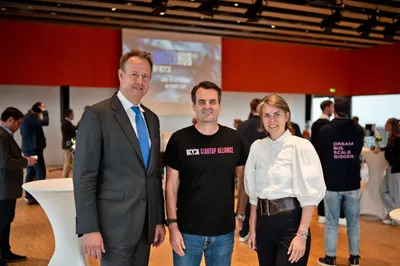
Driving the Water Transition Together
About RAG Aktiengesellschaft
As a post-mining company, RAG takes long-term responsibility for the ecological, technical and social consequences of mining. Through innovation and transformation, RAG is shaping sustainable solutions for people, nature and the region.
Key Facts:
- Active in North Rhine-Westphalia and the Saarland
- Manages 110 million m³ of mine water per year
- Purifies 900,000 m³ of groundwater annually
- Target: carbon neutrality by 2030
- Focus areas: environmental tech, renewable energy, digitalisation
Current Challenges: Balancing legacy and transformation
What are the most pressing challenges in your field right now?
“RAG faces the major task of managing its perpetual obligations in a sustainable and reliable way, from mine water management to environmental restoration. At the same time, it’s about actively shaping the future of former mining regions through digitalisation, securing skilled workers and open social dialogue, while living up to our responsibility as a post-mining company.”
Which developments do you expect to have the biggest impact on your business in the coming years – whether as a challenge or a driver?
“The biggest challenges for RAG arise from developments that are both opportunities and risks. The capital market determines the financing of our perpetual obligations, digitalisation offers efficiency but also demands new competencies, and the implementation of these tasks requires transparency and trust, especially in former mining regions.”
Innovation Focus: From mine water to new solutions
In which innovation fields are you active today and which topics do you want to drive forward with startups, research and the BRYCK Startup Alliance?
“Together with BRYCK Startup Alliance, we are advancing the Water Innovation Cluster to develop innovative solutions for the most valuable resource of all: Water. Our current focus is on leak detection and water analytics, with further potential for expansion.”
Which technologies or solutions are particularly relevant to you?
“For RAG, several technologies are becoming increasingly important. One example is the use of mine water as a heat source for residential areas, with a pilot project already underway in Bochum. AI-based monitoring systems help us detect risks earlier and manage our perpetual obligations more efficiently. Robotics, digital twins and open innovation platforms also simplify our work and contribute to stability and safety in former mining regions.”
Ecosystem: Building bridges between knowledge and practice
What’s your main goal in partnering with the BRYCK Startup Alliance?
“The cooperation between BRYCK Startup Alliance and RAG connects post-mining expertise with new approaches from the innovation ecosystem. This helps us find faster and more efficient solutions to our challenges while supporting young companies. In doing so, we contribute to sustainable structural change in the region and beyond and strengthen collaboration between institutions and companies focusing on water management.”
How can the BRYCK Startup Alliance accelerate the transfer of research into business practice?
“The BRYCK Startup Alliance accelerates the transfer of research into practice by connecting science and startups, enabling pilot projects and providing access to infrastructure and funding. Together with ecosystem partners such as investors, researchers and startups in the Water Innovation Cluster, we turn good ideas into market-ready solutions faster and closer to real-world needs.”
Why is it important to build an ecosystem rather than relying on single partnerships when it comes to transferring research into the economy?
“An ecosystem is more than a network. It allows research to be applied, not just exchanged. When science, startups, industry and society come together, dynamic spaces emerge where ideas grow faster, are tested and translated into practice.”
Looking ahead ten years from now: how would you describe a successful partnership with the BRYCK Startup Alliance?
“A successful partnership means developing solutions that make our perpetual tasks, such as mine water management, more efficient and sustainable, while serving as best practices for the water sector. If startups develop technologies for the geothermal use of mine water or AI-based monitoring systems, we aim to implement them regionally and make them visible internationally. The challenges we face – from climate adaptation to sustainable resource management – are universal. Our goal is to position the Ruhr region as an innovation hub that provides solutions to global challenges.”
Startup Collaboration: New perspectives that create progress
Have you had successful collaborations with startups in the past? Please share one or two highlights.
“Our collaboration with the AI startup AmberSearch has been a real success. Together, we developed an in-house AI solution that uses company-wide data to create a secure, privacy-compliant environment for generating our own AI-driven insights. Within the BRYCK WaterHub, we are also working on two promising pilot projects with Acquaint and SpectroMarine. Acquaint’s inspection technology enables us to identify potential leaks and critical reductions in wall thickness in shaft pipelines, even at depths of up to 1,000 metres. SpectroMarine, on the other hand, is piloting real-time water analytics using optical spectroscopy to detect changes in mine water quality directly on site.”
What have you learned from these collaborations that could also inspire others?
“Approaching the same topic from different perspectives and working styles is always enriching. Fast and sometimes unbureaucratic ways of finding solutions help us step out of our comfort zone and rethink long-standing habits. Startups work at a different pace and are often more flexible. That doesn’t always mean they are more efficient, but there’s a lot we can learn from each other.”